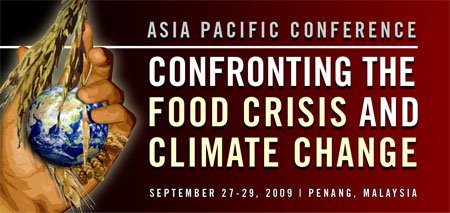
Following a recap by Dr Meriel Watts on the activities of Day One and Two, Clare Westwood of PAN AP presented a draft of the Consolidated Plan of Action, which pulled together issues and action plans from the plenaries and workshop sessions.
The Plan broke down the issues into the following groups: Policy Advocacy; Awareness, Campaigning and Network Building; Research and Documentation; and Capacity Building and Adaptive Strategies.
The Policy Advocacy section highlighted issues such as fair wages, genuine agrarian reform and creating a national platform for food sovereignty. It was emphasized that women's voices need to be heard and their visibility increased. A review of UN documents and plans for a Global Day of Action on December 12 in Copenhagen were some of the strategies of the section, among many others.
For Awareness, Campaigning and Movement-Building, seed exchanges and NGO networking were suggested. Also, media and youth outreach and increasing the links with consumers were seen as strategies going forward. Engaging other sectors, such as the media, film makers, and musicians were also new ideas for increasing awareness.
In terms of Research and Documentation, farmer-led research was emphasized as a key strategy for documenting the impact of the food and climate crisis. One suggestion was also to document the differences in nutrient density of GE food compared with traditional varieties, as often the GE varieties have been found to have lower nutritional value. Standardization of documentation and monitoring of government funding were also suggested, as well as community maps and documentation of indigenous lands.
Capacity Building and Adaptive Strategies were discussed, particulary the promotion of local markets and creation of job opportunities and livelihood options for small food producers. One idea was to include climate change programs in universities, and another was to provide training on alternative health strategies. In addition to many other ideas, it was emphasized that increasing the capacity of farmers to analyse the issues has to be a key focus going forward.
Showing posts with label consumers. Show all posts
Showing posts with label consumers. Show all posts
Tuesday, September 29, 2009

Monday, September 28, 2009
Workshop Sessions - Day 1
Sunday’s afternoon sessions featured six interactive and lively workshop groups: Peasants/Livestock Keepers, Indigenous Peoples, Agricultural Workers, Women, Fisherfolks and Consumers. Each group took advantage of the experience of its participants, sharing the challenges and opportunities of the different countries represented.
Workshop 1 – Women
The Women’s Workshop had 15 participants representing 6 countries (including one male). It featured two presentations, one from the Philippines and another from Uttarakhand, India. The situation of climate change, its situation, impacts and effects were discussed, including experiences of different countries. In Sri Lanka, for example, the tsunami left women and children the most vulnerable and marginalized. Several responses were suggested, including policy reform, changes to public distribution systems, access to land for women, and specific crises and situations of countries. Women have been impacted in a number of ways, including decreased biodiversity, good security, lack of education and information, and displacement.
Workshop 2 – Peasants and Livestock Keepers
The Peasants and Livestock Keepers Workshop included participants from 5 countries. The group identified problems that have resulted from climate change, such as erratic monsoons, exploitation of water resources, increased pest attacks, decrease in traditional crop varieties, and the poor responses of institutions. In order to come up with an effective people’s response, the group had several ideas including the revival of traditional seed varieties, increased networking between people’s organizations and communities, transparency in government policies and promotion of biodiversity-based ecological agriculture (BEA).
Workshop 3 – Indigenous People
HIGHLIGHTS OF WORKSHOP
I. Impact of Food Crisis and Climate Change
• Farmers suffer a lot from unpredictable weather unlike 30 years ago when they can confidently plan for planting and harvesting season. There is a tendency of having no food for next season as a consequence.
• Indigenous people are veering away from agriculture as they are moving towards cash economy and they are face poverty. They do not have money to plant crops which requires a lot of capital (farm) input.
• They themselves become destroyers of nature as what is being done by people in corporate agriculture.
• People are becoming individualistis because of this kind of economy (where they seek easy cash), they are not united anymore. Thus they cannot easily solve their problems, they become weak in spirit.
• People are leaving agriculture especially the educated (younger) generation. They do not appreciate the value of agriculture since planting requires a lot of money and farmers are always in debt.
II. Recommendations from participants
• Struggle in order to have control on land and agricultural practice
• Bring back the land to the people
• Revive the indigenous way of life. This is a sustainable way where traditional knowledge and practice are applied.
• Knowledge on ecologically sound practices should be pushed and popularized
• Promote organic farming, it is not a fast process but there is a gurantee for success based on experiences from various countries
• Document community maps of IP's lands. We should intensify work on this but this information should stay in the community since they are the owners and nobody else.
Workshop 4 – Agricultural Workers
19 people from Southeast Asia, South Asia, North America and Europe attended the workshop. Specific needs of agricultural workers were identified, as well as the differences between countries. Major issues were the conversion of food land to cash crop/monoculture agriculture, pesticide and water intensive agriculture, land conversion, the loss of power among farmers to control crops and lands, and the tendency of farmers to become contract farmers as land prices increase and farms are bought by large agribusinesses. The group came up with demands to be brought forth at the World Food Summit, and these included demanding the government devote resources to research and the impact of climate change, increased income sources for farmers, promotion of BEA and decrease of greenhouse gas emissions. They also called on NGOs and people’s organizations to document and collect evidence on traditional farming methods and knowledge, as well as to help provide links between consumers and agricultural workers.
Workshop 5 – Consumers
16 people from 9 countries attended the workshop on Consumers. The discussion focused on current research on consumer behaviour around the world. One study mentioned the concern of consumers in India, Brazil, China and Mexico; consumers in these countries were among the most concerned in the world, and most willing to pay more for eco-products. A number of suggestions emerged, including the need to link consumers and farmers through schemes such as Community Supported Agriculture, labeling, and people to people partnerships. It was also mentioned that policy changes and emphasis on educating students, institutions and new markets could be effective mechanisms for change.
Workshop 6 – Fisherfolk
The Fisherfolk group engaged in lively discussion on the current situation of fishing communities in South East Asia. There was an agreement that government inaction, decreased resources, and impacts of development projects are negatively impacting small fisherfolk. One issue identified was the difficulty in organizing communities, leading to challenges in changing government policy and effecting institutional change. With the increase in aquaculture, there has been increased marginalization of small fisherfolk and an increase in pest attacks and disease outbreaks. The subsequent discussion on alternatives included suggestions such as the formation of self-help groups, increased literacy among fishing communities, community management of resources, voter education and genuine fish
Workshop 1 – Women
The Women’s Workshop had 15 participants representing 6 countries (including one male). It featured two presentations, one from the Philippines and another from Uttarakhand, India. The situation of climate change, its situation, impacts and effects were discussed, including experiences of different countries. In Sri Lanka, for example, the tsunami left women and children the most vulnerable and marginalized. Several responses were suggested, including policy reform, changes to public distribution systems, access to land for women, and specific crises and situations of countries. Women have been impacted in a number of ways, including decreased biodiversity, good security, lack of education and information, and displacement.
Workshop 2 – Peasants and Livestock Keepers
The Peasants and Livestock Keepers Workshop included participants from 5 countries. The group identified problems that have resulted from climate change, such as erratic monsoons, exploitation of water resources, increased pest attacks, decrease in traditional crop varieties, and the poor responses of institutions. In order to come up with an effective people’s response, the group had several ideas including the revival of traditional seed varieties, increased networking between people’s organizations and communities, transparency in government policies and promotion of biodiversity-based ecological agriculture (BEA).
Workshop 3 – Indigenous People
HIGHLIGHTS OF WORKSHOP
I. Impact of Food Crisis and Climate Change
• Farmers suffer a lot from unpredictable weather unlike 30 years ago when they can confidently plan for planting and harvesting season. There is a tendency of having no food for next season as a consequence.
• Indigenous people are veering away from agriculture as they are moving towards cash economy and they are face poverty. They do not have money to plant crops which requires a lot of capital (farm) input.
• They themselves become destroyers of nature as what is being done by people in corporate agriculture.
• People are becoming individualistis because of this kind of economy (where they seek easy cash), they are not united anymore. Thus they cannot easily solve their problems, they become weak in spirit.
• People are leaving agriculture especially the educated (younger) generation. They do not appreciate the value of agriculture since planting requires a lot of money and farmers are always in debt.
II. Recommendations from participants
• Struggle in order to have control on land and agricultural practice
• Bring back the land to the people
• Revive the indigenous way of life. This is a sustainable way where traditional knowledge and practice are applied.
• Knowledge on ecologically sound practices should be pushed and popularized
• Promote organic farming, it is not a fast process but there is a gurantee for success based on experiences from various countries
• Document community maps of IP's lands. We should intensify work on this but this information should stay in the community since they are the owners and nobody else.
Workshop 4 – Agricultural Workers
19 people from Southeast Asia, South Asia, North America and Europe attended the workshop. Specific needs of agricultural workers were identified, as well as the differences between countries. Major issues were the conversion of food land to cash crop/monoculture agriculture, pesticide and water intensive agriculture, land conversion, the loss of power among farmers to control crops and lands, and the tendency of farmers to become contract farmers as land prices increase and farms are bought by large agribusinesses. The group came up with demands to be brought forth at the World Food Summit, and these included demanding the government devote resources to research and the impact of climate change, increased income sources for farmers, promotion of BEA and decrease of greenhouse gas emissions. They also called on NGOs and people’s organizations to document and collect evidence on traditional farming methods and knowledge, as well as to help provide links between consumers and agricultural workers.
Workshop 5 – Consumers
16 people from 9 countries attended the workshop on Consumers. The discussion focused on current research on consumer behaviour around the world. One study mentioned the concern of consumers in India, Brazil, China and Mexico; consumers in these countries were among the most concerned in the world, and most willing to pay more for eco-products. A number of suggestions emerged, including the need to link consumers and farmers through schemes such as Community Supported Agriculture, labeling, and people to people partnerships. It was also mentioned that policy changes and emphasis on educating students, institutions and new markets could be effective mechanisms for change.
Workshop 6 – Fisherfolk
The Fisherfolk group engaged in lively discussion on the current situation of fishing communities in South East Asia. There was an agreement that government inaction, decreased resources, and impacts of development projects are negatively impacting small fisherfolk. One issue identified was the difficulty in organizing communities, leading to challenges in changing government policy and effecting institutional change. With the increase in aquaculture, there has been increased marginalization of small fisherfolk and an increase in pest attacks and disease outbreaks. The subsequent discussion on alternatives included suggestions such as the formation of self-help groups, increased literacy among fishing communities, community management of resources, voter education and genuine fish
Subscribe to:
Posts (Atom)
