Day Two featured four interactive and lively workshop sessions: Biodiversity-based Ecological Agriculture (BEA), Gender Justice, Climate Justice, and Food Sovereignty. Following the sessions, group members shared their discussions and focus areas with the group in the final evening plenary. Below are some of the key points from each workshop.
BEA
The group discussed the elements of BEA, including the aims to improve livelihoods and support small producers and rural communities. They also discussed the opportunities for BEA, as well as the gaps, needs and plans going forward to the World Food Summit in Rome. Some of the opportunities are: premium pricing for organic and fair trade products, rich local knowledge, lobbying for local food and distribution systems, among many others. The group also discussed the gaps, including the lack of support for farmer research, decreases in biodiversity, and promotion of BEA at the UNFCCC, WFS and FAO.
Gender Justice
Ten people attended the session on Gender Justice, which was guided by the presentation by Dr Irene Fernandez earlier in the day. Strong suggestions for collective action came out of the session. Some of the action plans included: information and analysis of policies, linking organizations, policy advocacy, research and documentation, a focus on the impact on women, and the important call that women not be seen as victims, but as VOICES in the struggle against climate change.
Climate Justice
The Climate Justice group came up with a very focused plan of action for the COP 15 activities in Copenhagen in December. Several plans, including increasing the involvement of indigenous people and women, holding a national conference on climate change, networking with the media, holding side events at the COP 15 meeting, and sending a 10 person delegation to Copenhagen were suggested. The plans were further strengthened because the group set out a timeline and were organization-specific.
Food Sovereignty
The Food Sovereignty group had 17 participants from 7 countries. The differences between food sovereignty and food security were explained, and then there was a review of the People’s Statement on Food Sovereignty. Key strategies included focusing on traditional knowledge and the experience of indigenous people and small producers, fighting for fair wages, access to land, disaster response and national government policies. Mobilization activities were suggested, including furthering the action of YORA and holding events as part of Peasant Week in October. Themes included social environmental justice and strong policy advocacy. The IPC and IAASTD were brought up as venues for international policy advocacy and action.
Showing posts with label local agriculture. Show all posts
Showing posts with label local agriculture. Show all posts
Tuesday, September 29, 2009

Monday, September 28, 2009
Streams of Struggles: People’s Movements, Resistance and Alternatives
Food Sovereignty: Erpan Faryadi (AGRA Indonesia and the Asian Peasants Coalition)
Food sovereignty is at the heart of the work of PAN AP and its partner organizations, and represents local struggles for land, genuine agrarian reform and the people’s right to make decisions surrounding food production, consumption, trade and the environment. The Asian Peasant Coalition (APC) is an Asia-wide coalition of at least 20 million farmers, landless peasants, fisherfolks, agricultural workers, dalit, indigenous people, herders, pastoralists, women and youth representing 21 organizations from 8 countries. Their work towards genuine food sovereignty is one of local, national and international urgency, especially in the context of climate change and the food crisis.
Rice shortages are occurring across Asia, reportedly the worst in the last three decades, and in many places the price of food is skyrocketing, placing the most vulnerable in situations of food insecurity. Added to this are issues such as deforestation, neoliberal imperialist policies, hunger, landlessness and vulnerability of the people. The APC strongly believes that implementation of genuine agrarian reform is the ultimate solution to the food crisis. Governments should also control food prices, stop importation, give full support to rice productivity program and withdraw its membership to WTO.
Erpan Faryadi's presentation was followed by a presentation by Dr Irene Fernandez of Tenaganita on Gender Justice in Agriculture, which highlighted the special role of women in food production.
There was also a presentation on Climate Justice by Don Marut.
Following the presentations was a panel discussion 'Sharing Grassroots Experiences and Best Practices' in which Dr Charito Medina of MASIPAG, Vijay Jardhari of BBA and Sun Jing of PEAC shared their rich experience from many years of work. Participants were able to ask questions and make comments, showing the diversity and depth of knowledge present among the conference's participants.
Food sovereignty is at the heart of the work of PAN AP and its partner organizations, and represents local struggles for land, genuine agrarian reform and the people’s right to make decisions surrounding food production, consumption, trade and the environment. The Asian Peasant Coalition (APC) is an Asia-wide coalition of at least 20 million farmers, landless peasants, fisherfolks, agricultural workers, dalit, indigenous people, herders, pastoralists, women and youth representing 21 organizations from 8 countries. Their work towards genuine food sovereignty is one of local, national and international urgency, especially in the context of climate change and the food crisis.
Rice shortages are occurring across Asia, reportedly the worst in the last three decades, and in many places the price of food is skyrocketing, placing the most vulnerable in situations of food insecurity. Added to this are issues such as deforestation, neoliberal imperialist policies, hunger, landlessness and vulnerability of the people. The APC strongly believes that implementation of genuine agrarian reform is the ultimate solution to the food crisis. Governments should also control food prices, stop importation, give full support to rice productivity program and withdraw its membership to WTO.
Erpan Faryadi's presentation was followed by a presentation by Dr Irene Fernandez of Tenaganita on Gender Justice in Agriculture, which highlighted the special role of women in food production.
There was also a presentation on Climate Justice by Don Marut.
Following the presentations was a panel discussion 'Sharing Grassroots Experiences and Best Practices' in which Dr Charito Medina of MASIPAG, Vijay Jardhari of BBA and Sun Jing of PEAC shared their rich experience from many years of work. Participants were able to ask questions and make comments, showing the diversity and depth of knowledge present among the conference's participants.
Friday, September 25, 2009
Profile: Antonio Tujan Jr.
Antonio Tujan is a social activist who has worked on international issues and those relating to the Philippines for forty years. One of the founders of the Philippines-based IBON Foundation thirty years ago, he is the foundation's current International Director. Mr. Tujan Jr. is a researcher, editor, educator, and writer, and he is also the Director of the Institute of Political Economy. He has written and/or edited a number of articles and books on globalization and related issues, including: Globalizing Philippine Mining, Contract Growing - Intensifying Corporate Control of Agriculture, and The Impact of the WTO Agreement on Agriculture.
Mr. Tujan is active in international networking, and is the Chairman of both the Asia Pacific Research Network, a network of more than fifty major research non-governmental organizations in the Asia Pacific, and of Reality of Aid, a global network on poverty eradication. He is also Chair of the International Steering Group of the Civil Society Parallel Process to the Accra High Level Forum.
Mr. Tujan is active in international networking, and is the Chairman of both the Asia Pacific Research Network, a network of more than fifty major research non-governmental organizations in the Asia Pacific, and of Reality of Aid, a global network on poverty eradication. He is also Chair of the International Steering Group of the Civil Society Parallel Process to the Accra High Level Forum.
Thursday, September 24, 2009
Profile: MONLAR
MONLAR – Sri Lanka
Speaker: Sarath Fernando
The Movement for National Land and Agricultural Reform (MONLAR) is based in Rajagiriya, Sri Lanka. Borne out of the socio-political and economic crisis that emerged in Sri Lanka in the late 1980s, the movement began in 1990 as a network of farmer organizations, NGOs and people’s organizations. It promotes a vision of alternative sustainable development, including emphasizing the key role of women in agriculture and alternatives to “free market” export-oriented growth models. MONLAR works as a network, collaborating with organizations at the regional, national and international level. Issues of concern include: livelihood protection, the environment, food security, poverty and discrimination.
Speaker Sarath Fernando is the Co-Secretary of MONLAR. More information can be found at: www.monlar.net
Speaker: Sarath Fernando
The Movement for National Land and Agricultural Reform (MONLAR) is based in Rajagiriya, Sri Lanka. Borne out of the socio-political and economic crisis that emerged in Sri Lanka in the late 1980s, the movement began in 1990 as a network of farmer organizations, NGOs and people’s organizations. It promotes a vision of alternative sustainable development, including emphasizing the key role of women in agriculture and alternatives to “free market” export-oriented growth models. MONLAR works as a network, collaborating with organizations at the regional, national and international level. Issues of concern include: livelihood protection, the environment, food security, poverty and discrimination.
Speaker Sarath Fernando is the Co-Secretary of MONLAR. More information can be found at: www.monlar.net
Profile: Devinder Sharma and the Forum for Biotechnology and Food Security
Forum for Biotechnology and Food Security - New Delhi, India
Speaker: Devinder Sharma
The Forum for Biotechnology & Food Security is an independent collective of agricultural scientists, biotechnologists, economists, farmers, and policy makers based in New Delhi, India. Its work focuses on the controversial technology of genetic engineering (GE) in food crops and the effects of GE on small farmers. It has engaged in policy work with the Prime Minister, which resulted in the initiation of a high-level enquiry into the dubious role of the Department of Biotechnology (DBT) of the Ministry of Science and Technology in supporting, promoting and hastily pushing the controversial genetically modified crops onto gullible Indian farmers.
Devinder Sharma is an award-winning journalist, writer, thinker and researcher respected for his views on food and trade policy. His writings focus on the links between biotechnology, intellectual property rights, food trade and poverty. He is a regular contributor to leading national print publications. He is keenly involved with AgBioIndia, a daily email bulletin to bring the politics of food, agriculture and trade to the people. His recent works include two books: ”GATT TO WTO:SEEDS OF DISPAIR” and "IN THE FAMINE TRAP."
(Some information taken from www.indiatogether.org, last accessed September 24, 2009).
Speaker: Devinder Sharma
The Forum for Biotechnology & Food Security is an independent collective of agricultural scientists, biotechnologists, economists, farmers, and policy makers based in New Delhi, India. Its work focuses on the controversial technology of genetic engineering (GE) in food crops and the effects of GE on small farmers. It has engaged in policy work with the Prime Minister, which resulted in the initiation of a high-level enquiry into the dubious role of the Department of Biotechnology (DBT) of the Ministry of Science and Technology in supporting, promoting and hastily pushing the controversial genetically modified crops onto gullible Indian farmers.
Devinder Sharma is an award-winning journalist, writer, thinker and researcher respected for his views on food and trade policy. His writings focus on the links between biotechnology, intellectual property rights, food trade and poverty. He is a regular contributor to leading national print publications. He is keenly involved with AgBioIndia, a daily email bulletin to bring the politics of food, agriculture and trade to the people. His recent works include two books: ”GATT TO WTO:SEEDS OF DISPAIR” and "IN THE FAMINE TRAP."
(Some information taken from www.indiatogether.org, last accessed September 24, 2009).
Media Advisory - For Immediate Press Release
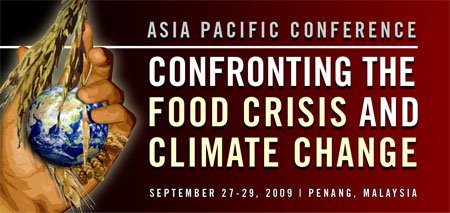
The Pesticide Action Network Asia and the Pacific will host an international conference entitled “Confronting the Food Crisis and Climate Change” to be held from the 27th-29th September at the Copthorne Orchid Hotel in Penang, Malaysia. The conference will feature over 100 participants representing countries from the Asia Pacific region, Africa, North America and Europe.
The conference will also feature a Biodiversity Bazaar open to the public on the 27th September at the Copthorne Hotel. The Bazaar will be held from 1-4pm and will showcase local foods, handicrafts, and entertainment as well as provide information on PAN AP’s Year of Rice Action campaign.
The world is in the throes of what is turning out to be one of the worst global recessions of the century. This was preceded by the Rice Crisis and Food Crisis of 2008, which resulted in food riots in many countries. Paradoxically, this is happening in a world that produces enough food for all people, and is being compounded by the interrelated problem of global climate change.
According to the United Nations, Asia is particularly vulnerable to climate change and natural disasters. The effects have already been seen in the form of flooding, unpredictable rains, droughts, rising sea levels, hurricanes, mudslides and other climate variations. The impact on food producers is staggering, with small farmers, pastoralists, fisherfolk, peasants and gatherers among the worst affected.
Recognizing the urgent need to address these issues and come up with solutions that strengthen people’s movements, food sovereignty and climate justice, the conference will feature the following specific objectives:
• To analyze the causes and impacts of the food crisis and climate change from the people's perspective and to share the responses of people's movements (namely, peasants, agricultural workers, indigenous peoples, rural women, fisherfolk, and consumers).
• To critically analyze the role and responses of transnational corporations, multilateral institutions, bilateral agreements, IFIs and governments in the food and climate crises.
• To identify critical areas for regional and global action.
• To develop collective strategies to address the critical areas.
• To build solidarity and unity among people's movements in addressing the crises.
For further information please contact:
Pesticide Action Network Asia and the Pacific (PAN AP)
P.O. Box 1170, 10850 Penang, Malaysia
Tel: +604-6570271/6560381
Fax: +604-6583960
Email: panap@panap.net
Email: sarojeni.rengam@panap.net
Email: voltaire.tupaz@panap.net
The conference will also feature a Biodiversity Bazaar open to the public on the 27th September at the Copthorne Hotel. The Bazaar will be held from 1-4pm and will showcase local foods, handicrafts, and entertainment as well as provide information on PAN AP’s Year of Rice Action campaign.
The world is in the throes of what is turning out to be one of the worst global recessions of the century. This was preceded by the Rice Crisis and Food Crisis of 2008, which resulted in food riots in many countries. Paradoxically, this is happening in a world that produces enough food for all people, and is being compounded by the interrelated problem of global climate change.
According to the United Nations, Asia is particularly vulnerable to climate change and natural disasters. The effects have already been seen in the form of flooding, unpredictable rains, droughts, rising sea levels, hurricanes, mudslides and other climate variations. The impact on food producers is staggering, with small farmers, pastoralists, fisherfolk, peasants and gatherers among the worst affected.
Recognizing the urgent need to address these issues and come up with solutions that strengthen people’s movements, food sovereignty and climate justice, the conference will feature the following specific objectives:
• To analyze the causes and impacts of the food crisis and climate change from the people's perspective and to share the responses of people's movements (namely, peasants, agricultural workers, indigenous peoples, rural women, fisherfolk, and consumers).
• To critically analyze the role and responses of transnational corporations, multilateral institutions, bilateral agreements, IFIs and governments in the food and climate crises.
• To identify critical areas for regional and global action.
• To develop collective strategies to address the critical areas.
• To build solidarity and unity among people's movements in addressing the crises.
For further information please contact:
Pesticide Action Network Asia and the Pacific (PAN AP)
P.O. Box 1170, 10850 Penang, Malaysia
Tel: +604-6570271/6560381
Fax: +604-6583960
Email: panap@panap.net
Email: sarojeni.rengam@panap.net
Email: voltaire.tupaz@panap.net
Tuesday, August 25, 2009
Share Your Thoughts on the Climate Crisis
Asia is particularly vulnerable to the climate crisis. According to the UN, Asia is the region most affected by natural disasters, almost 70% of which are climate-related. We have been experiencing the effects of climate change in the form of erratic rainfall, unpredictable flooding, rising sea levels, storms and hurricanes, droughts, rapid snow melt, mudslides and other climate variations. All of this is affecting our food production, its diversity and the quality of our crops and seeds. In fact, the majority food producers – small peasants, fisherfolk, pastoralists and gatherers - are the worst sufferers from the effects of climate change.
In the international discussions and agreements on climate change, agriculture has been identified as one of the causes of climate change. What do you think about this? Are small farming systems based on low- or no-chemical inputs contributing to climate change? If the answer is no, then we need to speak out. We need to emphasize that high input, chemically intensive, export-oriented agriculture is leading to cash crop monocultures and adding to the problems of climate change.
In fact, industrialization of agriculture has been adding to the climate crisis in several ways: through the establishment and operation of chemical-producing and polluting factories and through extensive fossil fuel-based road, air and sea transportation to carry both agriculture inputs and outputs (food products) over long distances (known as food miles). It is clear that if we wish to address the climate crisis, we need to have less corporate agriculture. But what is the alternative?
Biodiversity-based ecological agriculture (BEA), local food production and local consumption are practical solutions for mitigating as well as adapting to the climate crisis. These practices release lower amounts of greenhouse gases and allow the soil, water and air to recoup. Consumption of locally produced food minimizes transportation costs – both in terms of money and food miles. Moreover, locally and ecologically produced food is fresh, healthy and nutritious, and provides livelihood options for small food producers. Overall, this helps build community resilience against the impacts of climate change on food and the economy.
What are your thoughts on agriculture and the climate crisis? How should we address these problems? What are some strategies for promoting BEA and local food consumption? How can we promote safe, healthy, local food and link it to national and international advocacy initiatives?
Do you think people are becoming more concerned about the food they are eating and how it is reaching them? Do you feel the need to promote healthy local food availability? Do you feel it necessary to tell people what eating packaged food from the supermarket really means? Do you notice people missing some old food habits and items which have either been lost or are difficult to find, which need to be revived? Perhaps some traditional and local crops which were tasty and nutritious or were possible to grow in arid or flood conditions even? Do you think local food consumption would help local food producers? Is there a need to bring local food producers and consumers together?
Are you doing anything about it?
Please post your thoughts, comments, concerns and ideas. We’d welcome on this blog any information from your region – on climate change impacts, local resilience initiatives, ecological agriculture, safe food habits, local food traditions lost that need to be revived, including photographs.
In the international discussions and agreements on climate change, agriculture has been identified as one of the causes of climate change. What do you think about this? Are small farming systems based on low- or no-chemical inputs contributing to climate change? If the answer is no, then we need to speak out. We need to emphasize that high input, chemically intensive, export-oriented agriculture is leading to cash crop monocultures and adding to the problems of climate change.
In fact, industrialization of agriculture has been adding to the climate crisis in several ways: through the establishment and operation of chemical-producing and polluting factories and through extensive fossil fuel-based road, air and sea transportation to carry both agriculture inputs and outputs (food products) over long distances (known as food miles). It is clear that if we wish to address the climate crisis, we need to have less corporate agriculture. But what is the alternative?
Biodiversity-based ecological agriculture (BEA), local food production and local consumption are practical solutions for mitigating as well as adapting to the climate crisis. These practices release lower amounts of greenhouse gases and allow the soil, water and air to recoup. Consumption of locally produced food minimizes transportation costs – both in terms of money and food miles. Moreover, locally and ecologically produced food is fresh, healthy and nutritious, and provides livelihood options for small food producers. Overall, this helps build community resilience against the impacts of climate change on food and the economy.
What are your thoughts on agriculture and the climate crisis? How should we address these problems? What are some strategies for promoting BEA and local food consumption? How can we promote safe, healthy, local food and link it to national and international advocacy initiatives?
Do you think people are becoming more concerned about the food they are eating and how it is reaching them? Do you feel the need to promote healthy local food availability? Do you feel it necessary to tell people what eating packaged food from the supermarket really means? Do you notice people missing some old food habits and items which have either been lost or are difficult to find, which need to be revived? Perhaps some traditional and local crops which were tasty and nutritious or were possible to grow in arid or flood conditions even? Do you think local food consumption would help local food producers? Is there a need to bring local food producers and consumers together?
Are you doing anything about it?
Please post your thoughts, comments, concerns and ideas. We’d welcome on this blog any information from your region – on climate change impacts, local resilience initiatives, ecological agriculture, safe food habits, local food traditions lost that need to be revived, including photographs.
Subscribe to:
Posts (Atom)
