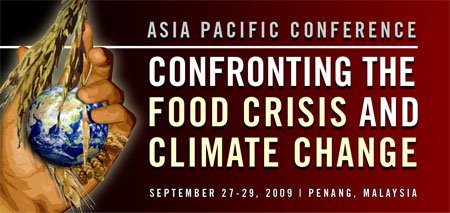
Following a recap by Dr Meriel Watts on the activities of Day One and Two, Clare Westwood of PAN AP presented a draft of the Consolidated Plan of Action, which pulled together issues and action plans from the plenaries and workshop sessions.
The Plan broke down the issues into the following groups: Policy Advocacy; Awareness, Campaigning and Network Building; Research and Documentation; and Capacity Building and Adaptive Strategies.
The Policy Advocacy section highlighted issues such as fair wages, genuine agrarian reform and creating a national platform for food sovereignty. It was emphasized that women's voices need to be heard and their visibility increased. A review of UN documents and plans for a Global Day of Action on December 12 in Copenhagen were some of the strategies of the section, among many others.
For Awareness, Campaigning and Movement-Building, seed exchanges and NGO networking were suggested. Also, media and youth outreach and increasing the links with consumers were seen as strategies going forward. Engaging other sectors, such as the media, film makers, and musicians were also new ideas for increasing awareness.
In terms of Research and Documentation, farmer-led research was emphasized as a key strategy for documenting the impact of the food and climate crisis. One suggestion was also to document the differences in nutrient density of GE food compared with traditional varieties, as often the GE varieties have been found to have lower nutritional value. Standardization of documentation and monitoring of government funding were also suggested, as well as community maps and documentation of indigenous lands.
Capacity Building and Adaptive Strategies were discussed, particulary the promotion of local markets and creation of job opportunities and livelihood options for small food producers. One idea was to include climate change programs in universities, and another was to provide training on alternative health strategies. In addition to many other ideas, it was emphasized that increasing the capacity of farmers to analyse the issues has to be a key focus going forward.
Showing posts with label genetic engineering. Show all posts
Showing posts with label genetic engineering. Show all posts
Tuesday, September 29, 2009

Thursday, September 24, 2009
Profile: Devinder Sharma and the Forum for Biotechnology and Food Security
Forum for Biotechnology and Food Security - New Delhi, India
Speaker: Devinder Sharma
The Forum for Biotechnology & Food Security is an independent collective of agricultural scientists, biotechnologists, economists, farmers, and policy makers based in New Delhi, India. Its work focuses on the controversial technology of genetic engineering (GE) in food crops and the effects of GE on small farmers. It has engaged in policy work with the Prime Minister, which resulted in the initiation of a high-level enquiry into the dubious role of the Department of Biotechnology (DBT) of the Ministry of Science and Technology in supporting, promoting and hastily pushing the controversial genetically modified crops onto gullible Indian farmers.
Devinder Sharma is an award-winning journalist, writer, thinker and researcher respected for his views on food and trade policy. His writings focus on the links between biotechnology, intellectual property rights, food trade and poverty. He is a regular contributor to leading national print publications. He is keenly involved with AgBioIndia, a daily email bulletin to bring the politics of food, agriculture and trade to the people. His recent works include two books: ”GATT TO WTO:SEEDS OF DISPAIR” and "IN THE FAMINE TRAP."
(Some information taken from www.indiatogether.org, last accessed September 24, 2009).
Speaker: Devinder Sharma
The Forum for Biotechnology & Food Security is an independent collective of agricultural scientists, biotechnologists, economists, farmers, and policy makers based in New Delhi, India. Its work focuses on the controversial technology of genetic engineering (GE) in food crops and the effects of GE on small farmers. It has engaged in policy work with the Prime Minister, which resulted in the initiation of a high-level enquiry into the dubious role of the Department of Biotechnology (DBT) of the Ministry of Science and Technology in supporting, promoting and hastily pushing the controversial genetically modified crops onto gullible Indian farmers.
Devinder Sharma is an award-winning journalist, writer, thinker and researcher respected for his views on food and trade policy. His writings focus on the links between biotechnology, intellectual property rights, food trade and poverty. He is a regular contributor to leading national print publications. He is keenly involved with AgBioIndia, a daily email bulletin to bring the politics of food, agriculture and trade to the people. His recent works include two books: ”GATT TO WTO:SEEDS OF DISPAIR” and "IN THE FAMINE TRAP."
(Some information taken from www.indiatogether.org, last accessed September 24, 2009).
Subscribe to:
Posts (Atom)
